
Neurodivergence Is Not the Problem!
The Comfort of Exclusion

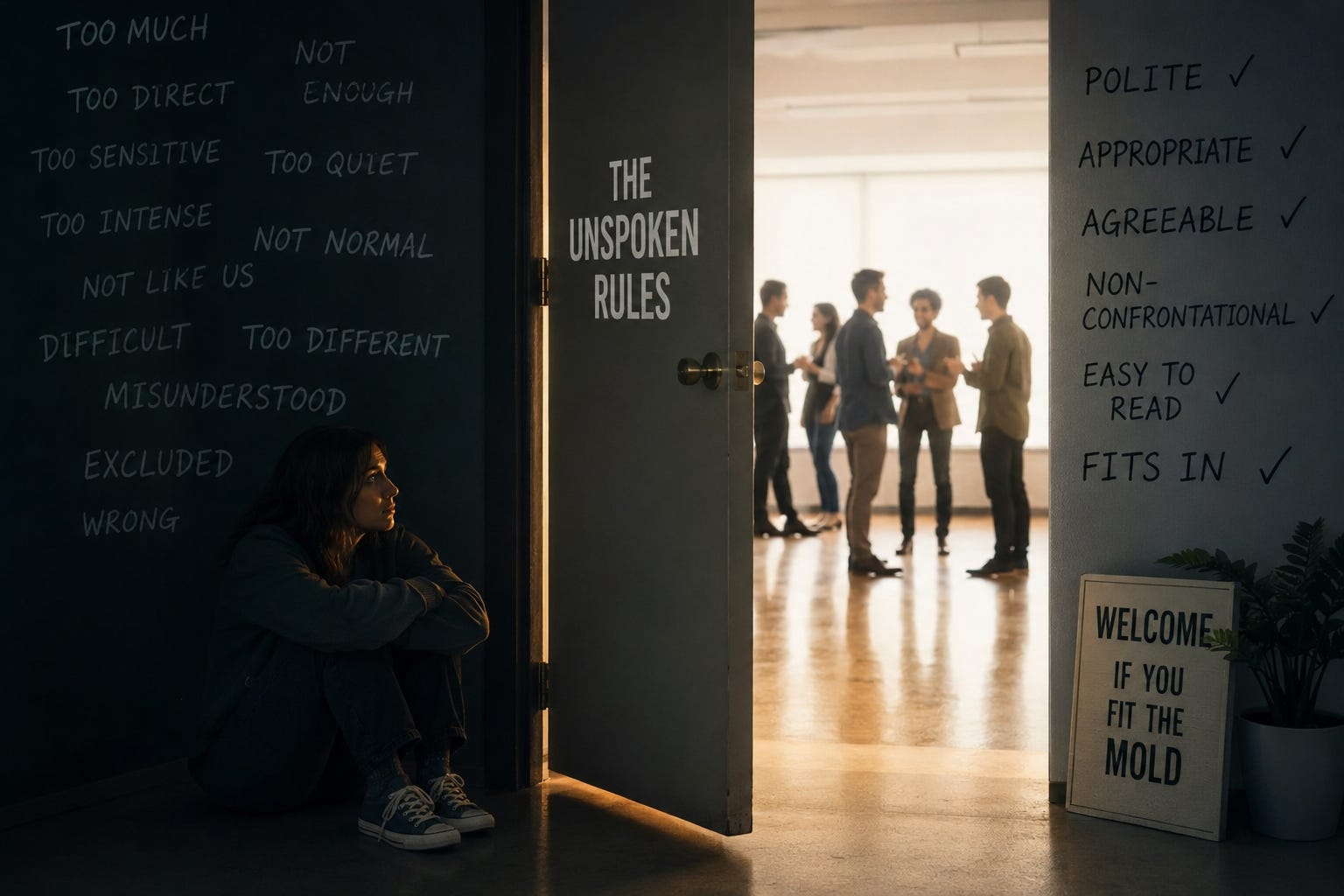
Someone was talking about me behind my back. A mutual friend told me. So I did what made sense — I went to her directly. Asked if we could talk. Said I’d heard something was wrong and I wanted to understand it.
She refused.
Not because I’d done anything. Because she couldn’t read me. My directness — the same directness that meant I came to her instead of talking behind her back — had already been filed as something to avoid. She’d seen me be honest in rooms where people usually perform. She’d mistaken clarity for something requiring distance. So when I tried to resolve something cleanly, what she did was withdraw.
She didn’t say why. My friend delivered the verdict: she’s told me what’s wrong but she doesn’t want you to know, or talk to you.
I wasn’t angry. I was confused. I’d done the honest thing and ended up with less information than when I started, penalised for trying to go directly to the source, which is — I thought — what you’re supposed to do.
I failed a test I didn’t know was being administered.
The test wasn’t are you trustworthy. The test was do you communicate the way people who are trustworthy are supposed to communicate. Softened. Indirect. Performing non-confrontation even when confrontation is the honest thing.
I didn’t perform it. I never do. And in that gap — between what I actually am and what I was expected to look like — she made a decision about who I was.
No malice. She wasn’t cruel. She processed the interaction through a social framework that felt true to her — and the world had never given her a reason to question it. Two nervous systems reading the same moment differently. That part I understand.
What I don’t understand — what I have never been able to understand — is the door closing with the information still inside it. Not discomfort with directness. The decision to leave me without an answer. Through every available channel, including the one already open.
That choice got to be called reasonable. Mine got called threatening.
That’s not a nervous system difference. That’s the system deciding whose discomfort counts.
This is not a story about one person.
This is a story about what happens when two people navigate the same moment through different nervous systems — and only one of those nervous systems gets to be called reasonable.
This is not about her. This is not even about me.
It is about what happens when one way of being human gets installed as the default, and everything that deviates from it gets read as error. Not consciously. Not cruelly. Just — quietly, consistently, across every room, every system, every institution that was built by the same kind of person, for the same kind of person, and then forgot to mention that’s what it was.
We call it a standard. We call it professional. We call it normal. We call it objective.
We don’t call it what it is: a description of one neurotype, promoted to universal truth.
And here is the part that took me the longest to see clearly: it doesn’t stay this way because of malice. There are no villains required. It stays this way because changing it would cost something. Not money. Not effort. Something more protected than either of those.
Comfort.
The comfort of a world that was built around you, that keeps confirming you, that never asks you to question whether the baseline you’re standing on was ever neutral to begin with. The comfort of systems that process you correctly, read you accurately, score you fairly — not because the systems are fair, but because you happen to match what fair was modelled on.
And underneath that comfort, something quieter still. Not indifference — indifference at least requires awareness. This is something more complete. A reality where the problem simply does not exist. Not ignored. Not avoided. Just genuinely absent from a life that has never once required looking there. It is what it is sounds like resignation. It sounds like nobody’s fault. But it is only available as a phrase to someone for whom it has never been anything else.
You cannot feel urgency about a wall you have never walked into.
That choice — to remain inside a reality where the wall doesn’t exist — made by enough people, across enough institutions, across enough centuries, is how the wall stays standing. Not ignorance. Not hatred. Unexamined defaults that have never been required to examine themselves.
The defaults of a world built around one way of processing, communicating, and moving through social space — defaults that feel like neutrality to the people they were built for, precisely because they have never been friction. You don’t notice the current when you’re swimming with it. You only feel it when you’re not.
Not a conspiracy. Not cruelty. Just the accumulated weight of a world that keeps mistaking its own familiar shapes for universal truth. And keeps asking everyone else to explain why they can’t seem to fit.
And then there are the people that article speaks of directly. The ones not diagnosed until they were already inside a prison system. Who had been seen as troublemakers their entire lives. Called names they didn’t recognise, didn’t understand, couldn’t map onto anything that felt like themselves. Labels that accumulated into an identity they hadn’t chosen — and eventually, because the world confirmed it so consistently, stopped fighting. Not because it was true. Because exhaustion has a limit, and the world had been very loud for a very long time.
Better just adapt. Everyone says I am anyway.
That’s not resignation. That’s the rational conclusion of a nervous system that ran the numbers and found no return on continued resistance. At some point the calculation changes. And when you adapt to the verdict, you confirm it. The thing you became to survive the label becomes the proof of the label. The system closes around you.
I know that feeling. Not as observation — as something I have felt in my body. The specific exhaustion of being described as difficult, troublesome, challenging authority, by people who never once asked what you were challenging or why.
It could have been me. I know that without any doubt. The difference between that path and mine was not strength or character or better decisions at critical moments. It was my mother.
Not because she argued with the verdict. Not because she sat me down and told me I was worth something. She did something quieter and more precise than that. She kept the door open. I love you and you’re welcome home. She would call — I still don’t know how she always knew where I was — and just say: I’ve made food, are you hungry? You need clean clothes, better come home and change.
And my logic mind, the same mind the world had spent years calling difficult, did exactly what it was built to do. It ran the calculation. She’s being kind. Kindness deserves kindness in return. Better go home.
She didn’t fight the logic. She worked with it. She still does. She is 92 years old and she still does.
She found the door that was actually open in me and walked through it quietly, every time, without making it something I needed to resist.
Because here is what the world never understood about us — the ones it called troublemakers. We can handle angry. Angry is a language we already speak. Anger confirms the verdict, gives us something to push against, something familiar to survive. We know how to meet anger.
What we cannot handle is the parent we have openly hurt. The disappointment of someone who was never trying to hurt us back. That has no defence. Because it doesn’t attack. It just loves. And your logic mind, braced for impact, suddenly has nothing to push against and everything to lose.
She didn’t save me from the world. She refused to confirm what the world had decided about me. And in the years when the verdict was loudest, that was the difference between a story that closed and one that stayed open.
I got that. Not everyone does.
But the system didn’t change because she loved me well. It was still there. It is still there. For everyone who didn’t get the call.
That is not a footnote. That is the point.
Here is what nobody tells you about growing up failing a test you don’t know exists.
You don’t experience it as systemic. You experience it as personal. Every time you’re too direct and the room shifts. Every time you resolve something honestly and it gets read as aggression. Every time you ask the question everyone else was thinking but somehow knew not to say out loud. Every time your face doesn’t perform the emotion the moment was expecting.
You don’t think: the baseline is wrong. You think: I am wrong.
That is the design. Not intentional design — nobody sat down and planned this. But design nonetheless. A world that consistently reflects one version of human back as correct will, over time, convince everyone who doesn’t match it that the problem is theirs to solve. So you spend decades solving it. Masking. Translating. Learning to perform the choreography of a neurotype that isn’t yours, well enough to pass, badly enough that it costs you everything it takes to maintain.
And here is the part that is almost too uncomfortable to say out loud: that internalisation — I am wrong, the baseline is correct, I need fixing — is not just personally devastating. It is structurally convenient.
A person who believes the verdict is about them spends their energy trying to fix themselves. They don’t name the mechanism. They don’t ask the questions the system cannot answer. They don’t become inconvenient. They quietly absorb the cost and the structure continues undisturbed.
The person who stops internalising and starts naming — who says this is systemic, the baseline was never neutral, the structure is failing me — is a completely different problem for the institution. That person makes the invisible visible. That person becomes, in the language already prepared for them: difficult. Troublesome. Challenging authority.
Which is precisely what they were called before they had the language to explain why.
This is not a new pattern. Women who named the structures producing their distress were hospitalised for it. Hysteria was not a medical diagnosis — it was a management tool. A way of returning a disruptive truth to the category of personal malfunction. Activists who named systemic violence as the source of their communities’ suffering were called unstable, dangerous, radical — not because they were wrong, but because being right about a system is the most threatening thing you can be inside it.
The label updates to fit the era. The function of the label does not move.
So you spend decades solving it instead. Masking. Translating. Learning to perform the choreography of a neurotype that isn’t yours, well enough to pass, badly enough that it costs you everything it takes to maintain.
The energy that goes into that translation is not small. It doesn’t show up on any balance sheet. Nobody measures it. But it is the reason the exhaustion is so specific — not the tiredness of someone who worked hard, but the tiredness of someone who worked hard at being someone else, in every room, for years, before they even had the language to describe what they were doing.
And when the masking slips — when the shutdown happens, when the directness comes out unfiltered, when the system encounters you as you actually are — it doesn’t say: oh, we weren’t accounting for this. It says: something is wrong with you.
The school said it. The workplace said it. The doctor said it, in different words, with a form that didn’t have a box for your presentation. The algorithm said it without saying anything at all — just a score, a filter, a door that didn’t open.
Always the same conclusion. Always pointing the same direction.
You.
Not the test. You.
And here is the part that breaks something open when you finally see it: the system was never trying to find out what you could do. It was trying to find out if you could perform being the kind of person it was built to recognise. Those are not the same question. They were never the same question. But for a very long time, you didn’t know there was a difference.
If every neurodivergent person simultaneously stopped absorbing the verdict and started naming the structure, the cost would become visible at a scale impossible to ignore. The system would either have to change — or reveal, with uncomfortable clarity, that it had no intention of doing so.
Both outcomes are more honest than what exists now.
The numbers are not the problem. We have enough numbers. We also have the cost efficiency data — well documented, not contested. Exclusion costs more than inclusion. In healthcare. In administration. In the compounding institutional weight of managing the consequences of a system that keeps producing the same consequences. And in lives. The ones never fully lived. The contributions never made. The innovations that never reached the room because the person carrying them didn’t pass the baseline test at the door.
The society that keeps excluding neurodivergent people is not protecting its resources. It is haemorrhaging them. But that would require looking at the baseline. And the baseline is comfortable.
So let’s be precise about what comfort actually is in this context.
It is not ignorance. You have the numbers now. It is not helplessness. The data on what needs to change is not ambiguous. It is not complexity. The direction is clear.
Comfort is the active choice to feel something about a problem that isn’t yours and then continue. To share the article. To say this needs to change. To mean it. And then to let the meaning dissolve back into a life that the system was built to support, while the wall stands exactly where it was when you started reading.
That choice has a cost. You just don’t pay it.
Someone else does. Every day. In every room. In every system that was built to process them as error. In every moment of exhaustion that doesn’t come from working hard but from the specific, relentless labour of existing in a world that keeps returning the same verdict.
You are wrong. You need fixing. Try again.
The verdict was never true. It was never about truth. It was about maintaining a world where one way of being human gets to be the default, and everyone who doesn’t match it absorbs the cost of that decision so that everyone who does match it never has to feel it.
That is what your comfort is built on.
The question is not whether you knew. The question is what you do now that you do.
In my honest opinion — I can take it. I have built the resilience. But it is heartbreaking watching people suffer in the meantime, while report after report, article after article keeps pointing fingers and nothing changes.
If you want to see what this looks like when it gets built into infrastructure — into hiring algorithms, healthcare systems, courtrooms, and classrooms — this documents it.

I absolutely relate to this post, everything except being comfortable with anger. I absolutely cannot deal with anger. It was too much of my childhood growing up. Brilliant post.
So the only solution I see is: Resist. Boicot. Be yourself.
I have an internal urge to put my resting bitch face on, if I don't do that I get burnt out after one day.
The same urge applies to a whole plethora of needs that people have.
Anyone can slowly start shifting the system in their surroundings, we have the ability to talk to people so lets do that.
I know, everyone has their boundaries and personal problems but you get the point, even just talking with your close fiends about this can produce an unexpected result.
This system was built to exclude neurodivergents (I hate this word), lets destroy it.
We exist, we deserve to be ourselves, we deserve to chill the fuck out as much as anyone else does.