
It Was Never About Getting In.
A misdiagnosis I carried for thirty years

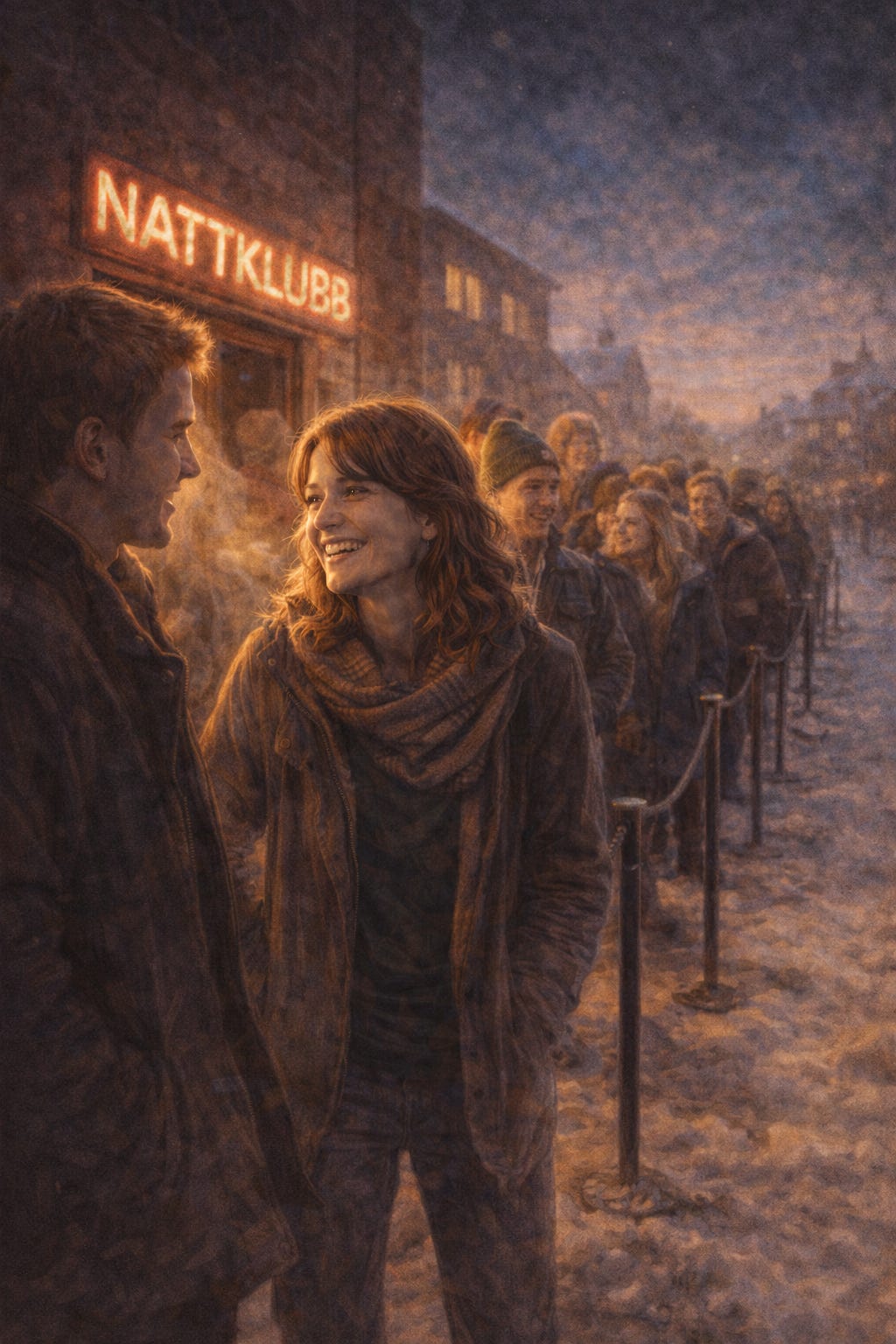
Six hours. That's how long we queued outside Krogen — the pub, literally named The Pub — before the doors opened. From 3PM in a Swedish university town, standing on pavement that didn’t get any warmer, waiting to get into a nightclub that wouldn’t start until 9. By the time they let us in — thirty, maybe sixty minutes before it officially began — we’d already had the night.
I’ve called this FOMO my whole life. The need to be there early, to not miss a single moment, to squeeze everything out of every available hour. It sounds like anxiety. It looks like anxiety. Everyone nodded when I used the word.
But anxiety is what you feel when you’re in the queue wishing you were inside.
That’s not what was happening.
I wasn’t suffering through six hours of waiting to get to the real thing. The queue was the real thing. The cold and the conversations and the nonsense and the strangers who became friends before we’d even heard a single song — that was the night. The club was almost the afterthought.
It wasn't FOMO back then. It was something I wouldn't understand for decades — chasing dopamine, chasing adrenaline, mistaking the rush for the reason.
But that version of me — the one who could stand in a queue for six hours and find it enough — didn’t survive the security years intact.
I spent over a decade at Securitas. Broken windows at 3AM. Chasing with the police. Racing cars through empty streets toward something that needed stopping. The radio crackling with a frequency that meant now, move, this matters. Your body learns that register. It learns it so completely that it stops feeling like a heightened state and starts feeling like the only real state there is.
Everything else starts feeling like waiting.
I didn’t understand what was happening to me. I knew I couldn’t sleep — but I filed that under willingness. I wanted to learn everything. Life is short. The world keeps moving and there’s so much of it to absorb, so many things to understand, so many situations to be useful in. Sleep felt like surrender. Like if I closed my eyes the frequency would keep transmitting and I’d miss the thing I was built to respond to.
I told myself I was an intellectual. Curious. Driven.
I was an adrenaline junkie who had found the perfect professional habitat for a dysregulated autonomic nervous system — and then couldn’t climb back out when the shift ended.
The FOMO wasn’t fear of missing a party. It was a nervous system that had been trained to treat stillness as a threat. Rest wasn’t recovery. Rest was the gap between transmissions where something could go wrong without you.
Of course I fooled myself. It felt so much like passion. It felt so much like being alive.
It was. Just not in a way that was sustainable.
The diagnosis came a year before the crash. Fibromyalgia. Aching I hadn’t felt before, a fatigue that sat in my bones rather than my muscles, and managers who looked at me and saw lazy. I filed it alongside everything else I didn’t have time to fully process and kept moving.
Then a relationship ended. And something that had been held together by velocity alone stopped having enough speed to stay airborne.
I don’t remember the threshold clearly. That’s the honest version. I found myself at the door to my flat not knowing if I was coming or going. I couldn’t remember where I’d parked the car. Couldn’t reconstruct how I’d gotten home. The sequence of the day was just — gone. I had to ask my doctor to ban me from driving because I couldn’t be trusted with the gap between intention and arrival.
The body had been asking for a long time. I hadn’t been listening — not because I didn’t care, but because the frequency I’d been trained to receive didn’t include that signal. Stillness was a threat. Rest was the gap between transmissions. My ANS had one setting and it had been running on it for over a decade.
When the body finally ran out of ways to ask, it stopped asking and just — stopped.
Not depression. Not weakness. Not laziness, whatever my managers thought they were seeing.
A system that had been running without adequate fuel, at unsustainable speed, in a body that was already fighting itself — and had simply reached the end of what was possible without a full shutdown.
The threshold was the bill arriving. Years of it, all at once.
There was a doctor who told me the truth.
Not kindly. Not with cushioning. Just — the truth, delivered the way you’d read a meter.
“Continue down this path and best case scenario, you’ll be in a wheelchair by your 40s. And besides that, we can’t afford to give you one.”
I cried. Not from sadness — from anger. The kind of anger that arrives when someone finally says out loud what your body has been trying to tell you for years and everyone around you called laziness. The anger of a bill arriving that you didn’t know you’d been running up because nobody told you the meter was running.
He watched me cry and said nothing. Just looked at me with an expression that said Good. Now you’ve started.
When I asked how long it would take to get cured he paused.
“As long as it’s taken you to get to this depleted state — if you’re lucky. Maybe never.”
He meant better. Probably. But maybe never is what I heard and maybe never is what I needed to hear — because it demolished the last version of the destination I was still holding onto. The one where I got back to full speed. Back to the frequency. Back to the transmissions and the racing cars and the 3AM broken glass.
That version of better was never coming.
What came instead was slower and stranger and — eventually — more honest. The realisation that the body keeping score had always been keeping score, long before the threshold, long before the security years, long before I learned to call stillness a threat.
And underneath all of it, still intact, still waiting — the memory of a queue outside a nightclub in a Swedish university town. Six hours on cold pavement. No frequency to monitor. No transmission to miss. Just the conversation happening right now, with the people standing next to you, in the only moment that existed.
I caught a glimpse of her this morning.
I was out for a stroll, stopped at a quiet road, and a tiny bird stopped me completely. One of the smallest spring birds there is, somewhere in the branches above me, with an ever-changing trill that made no sense coming from something that small. I stood there searching the tree, not finding it, just listening — until I noticed someone standing beside me that I hadn’t heard approach.
They looked at me and said: “You made us stop and look for the bird as well.”
I could only say: “Some pretty decent lungs and vocal cords on something that small, huh.”
We stood there together for a moment — two strangers, stopped by the same invisible thing — and then went our separate ways smiling.
That was the queue. Right there on a quiet road in March. No destination. No transmission. Just the only moment that existed.
I didn’t have FOMO then. I had everything.
It’s been years now and I still cry out of anger at what could have been — even though I don’t regret what was. It humbled me. It bettered me. It stripped away the version of myself that confused velocity with living and adrenaline with passion.
The FOMO is still there. I won’t pretend otherwise. But it’s manageable now — which is a word I once would have treated as defeat and have slowly learned to treat as enough.
I’m still learning that the queue is the point.
I always knew it. I just forgot for a while.
I really enjoyed reading this - thank you for sharing it. So often we are in such a rush to get to a destination and experience the 'event' that we miss the moments along the way.
I'm one of the people that stop, look for the small things and engage with others who marvel.
with age we learn to listen to our body more and less to the noise of the tribe that instead of growing keeps pushing the same tired ways that never worked but for those running the show... Good article. I saw it on my friend's wall and came to read it. Fibromyalgia is very tiring, many people don't know how it can feel. I had friends with it.... and many people fail to understand it's not laziness. Blessings.