
Is It Though?
The Personality You Nominated

Watching TikTok reels and news videos, seeing these “Oh, you’re wild, sister! -LMAO-”, “Man, your personality is out of this world!? -hahahaha!-” or just people watching around town, my first and initial question is always “Is it though?”
Performative appearances… for clicks, clout and cheering.
This is who I am!
Again.. is it though?
But scroll past the performance and the question doesn’t go away. It just gets quieter and closer to home.
Which version of you did you introduce at your last job interview? Which one shows up at your mother’s dinner table? Which one emerges at 2am when something has broken and there’s no audience left?
Same person. Notably different configurations.
So when you say “this is my personality” — which one are you pointing at? And who decided that one was the definitive version?
Most people nominate the version they’re most comfortable with. Or most proud of. Or most often seen in.
The competent one. The funny one. The calm one. The one that gets the best reaction from the room they’re most invested in.
The others get filed differently.
“I was tired.” “That situation brings out the worst in me.” "I'm not like that normally." — as if normal were a place you reliably return to. As if anyone does.
But you were like that. In that moment, with those conditions, that version showed up — reliably enough that the people in the room weren’t surprised. Which means it wasn’t an aberration. It was just a configuration you don’t claim.
Here’s the problem with the nomination: you didn’t choose it consciously. It chose itself. The version that got the most approval, the least friction, the most consistent reward — that’s the one that got filed as the real one. The others became footnotes.
Personality, in this reading, isn’t something you have. It’s something you do — repeatedly, recognisably, but never identically. And the version you call “me” is the one that got the most airtime in the rooms that mattered most to you.
Which raises an uncomfortable question: if the output shifts with conditions, state, audience and energy — what exactly are we claiming to measure when we call it personality? And where is the stable thing we're pointing at when we say "this is me?"
I quite often hear this … “This is who I am, transparent, you get what you see”
But who are you, really? And while we’re here — who am I? Can anyone really answer this?
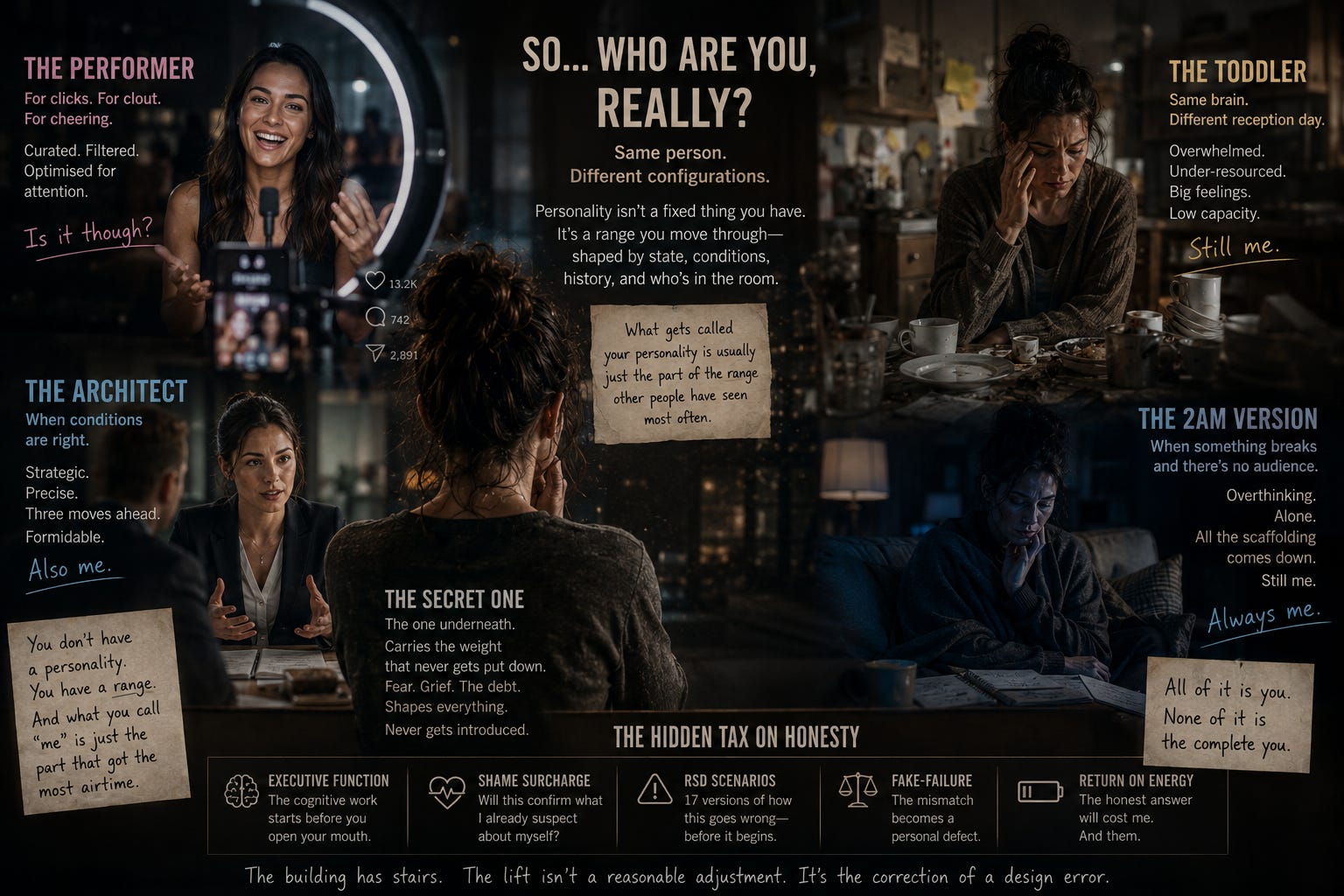
Meet the Architect.
She shows up when conditions are right. Slept enough. HRV stable. Inbox not on fire. She sees systems, patterns, three moves ahead. She is precise, strategic, occasionally intimidating. She can hold a complex argument in working memory while building the counter to it in real time. She is, by most external measures, formidable.
Now meet the Toddler.
Same person. Same brain. Same signal. Different reception day.
The Toddler cannot find her keys. Cannot start the thing she knows needs starting. Is overwhelmed by the dishes. Has opinions approximately the size of a small weather system and the executive function of a golden retriever who has just seen a squirrel. She is not broken. She is not lazy. She is the same receiver running on a depleted power supply in a high-noise environment.
And then there’s the one who loses the words mid-conversation. Not because she has nothing to say — the thoughts are there, fully formed, running at full speed. But the connection between the internal signal and the vocal output simply isn’t available. The body has made a unilateral decision about capacity and didn’t consult the diary. She isn’t absent. She isn’t disengaged. She is present and completely unreachable at the same time.
That one rarely gets claimed as the personality either. But she shows up. Reliably. Under specific conditions. Which makes her as real as any of the others.
All are me. None is a performance. None is the real one.
So which one is my personality?
The one you’d meet at a conference would say Architect, obviously. The one my kitchen has met on a Tuesday morning at low battery would beg to differ and so does the one lost for words while locked in the mind alone.
This is the thing personality frameworks never account for: state. Not mood — state. The hardware condition the receiver is running on at any given moment. HRV. Sleep debt. Sensory load. Stress accumulation. These aren’t excuses for behaviour. They’re the actual operating conditions that determine which configuration shows up.
You don’t have a personality. You have a range. And what gets called your personality is usually just the part of the range other people have seen most often.
And then there’s the one nobody sees.
Not the Architect. Not the Toddler. The one underneath both of them — the one carrying the weight that never quite gets put down. The personal debt that accumulated quietly over decades of calibrating, masking, getting it wrong in ways nobody explained and you couldn’t name. The fear that lives below the competence. The grief that sits underneath the wit.
That one doesn’t show up at conferences. Doesn’t make it into the TikTok reel. Doesn’t get introduced at dinner parties.
But it’s there. Shaping everything. The negative space inside the personality you nominated.
And it might be the most accurate version of all — not because suffering is more real than capability, but because it’s the one that was never performed for anyone. Not even yourself, if you could help it.
So if personality isn’t a fixed thing you have — what is it?
Here’s where it gets interesting.
The receiver model of consciousness suggests that the brain doesn’t generate experience — it receives and processes it. It’s an interface, not a source. What comes through, and how it gets interpreted, depends on the configuration of the processing layer. The hardware state. The filters. The default settings built by genetics, experience, trauma, culture, and time.
Personality, in this framework, is the characteristic configuration of that processing layer.
Not who you are. How you process.
The default filters. The habitual responses. The patterns of reception that show up consistently enough that other people learn to predict them — and that you learn to call yourself.
It’s real. It’s just not fixed. And it’s not fully accessible even from the inside — you can’t stand outside your own processing layer and examine it objectively any more than an eye can see itself without a mirror.
What personality tests measure is the radio at rest. The default settings in controlled conditions. They’re not wrong exactly — they capture something. But they miss the range, the state-dependence, the secret configurations, the 2am version, the version under pressure, the version in grief.
They measure the output. Not the thing generating it.
If this sounds like I’m suggesting we’re machines with antennas — I’m not. A machine processes without experiencing. What makes the human receiver extraordinary is precisely that it doesn’t just process. It feels the signal. It is changed by it. It carries it.
The model isn’t reductive. It’s the opposite. You are larger than your outputs.
Who’s broadcasting? That’s a different article. A longer one. The short answer is: nobody knows, and anyone who tells you otherwise is selling something. But the signal could be real regardless of whether we can locate its source.
Which means every “this is who I am” is actually “this is what my processing layer produces under these specific conditions.”
Accurate. Incomplete. And considerably more interesting than a four-letter personality type.
The receiver model doesn’t dissolve responsibility. It relocates it. If you know your hardware conditions affect your configuration — and you do, because you’ve lived it — then managing those conditions becomes the accountability. You don’t get to harm someone and call it a bad reception day. You get to learn which conditions produce which configurations, and take responsibility for the ones you can influence.
Knowing the mechanism isn’t an alibi. It’s an obligation.
So who are you, really?
Larger than the version you nominated. More variable than the one that got the most airtime. More complex than the configuration other people learned to predict and call you.
You are the Architect and the Toddler and the secret one underneath both of them. You are the 2am version and the conference version and the one that shows up at your mother’s table doing the calibration so automatically you don’t even notice anymore. You are the one performing for clicks and the one alone on the couch in the silence that finally feels like enough space to breathe.
All of it is you. None of it is the complete you.
The “transparent, you get what you see” version? Also you. Just the one with the least noise between the signal and the surface on a good day. Which is worth something. It’s just not the whole story.
I used to ask people — half seriously, half genuinely curious — “aren’t we all a little plural? All carrying more than one version of ourselves?” The reaction was immediate and almost always the same. Defensive. Occasionally furious. “I am not sick.” Which wasn’t what I said. But the word plurality — the suggestion that the self might not be singular and fixed — landed as a threat before the actual question could register.
That reaction is worth examining.
The need to be a coherent, consistent, singular self is doing enormous psychological load-bearing. It organises identity, maintains relationships, justifies decisions, provides continuity across time. Threatening it doesn’t feel like an interesting philosophical proposition. It feels like pulling the floor up.
But the floor was always a construct. A necessary one, perhaps. A useful one, often. Just not the literal ground.
Personality isn’t a fixed point you arrived at and now inhabit. It’s a range you move through — shaped by state, conditions, history, and who’s in the room. The configuration that shows up most consistently isn’t the truest one. It’s just the most practiced one.
You are not too much. You are not too little. You are not the worst version that showed up under pressure or the best version that showed up when conditions were finally right.
You are the receiver. The whole range of it.
That’s not a personality type. That’s a life.
And maybe the better question was never "who are you?" It was always "what are you like — and under what conditions?"
You know I wrote about this in my book. We talked about it at length. You've explained it perfectly here. This is the mask we wear.